
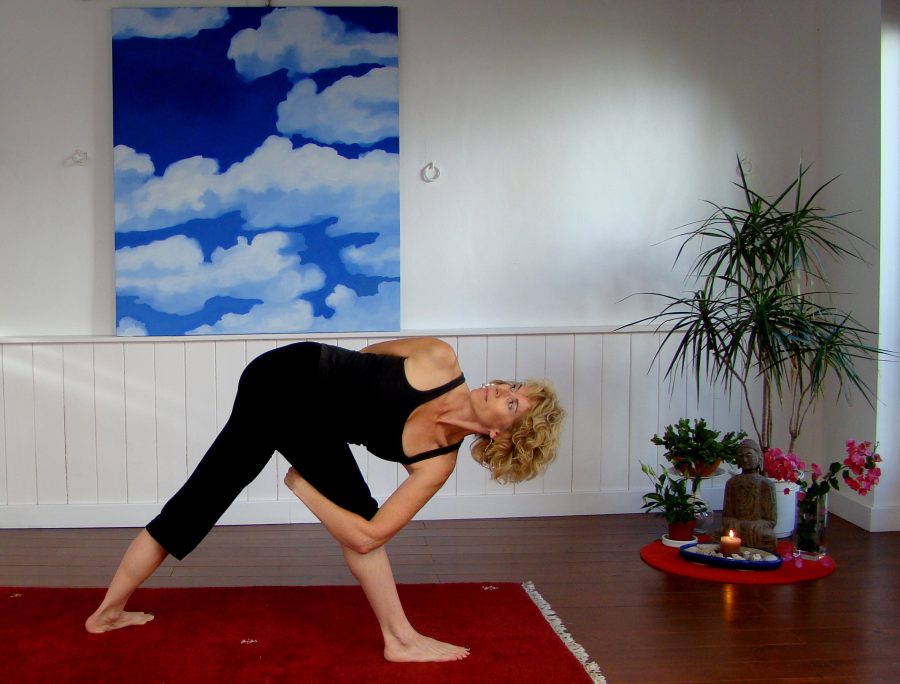
Umm, good question!
As a yoga teacher this is something I’ve often been asked – and it’s a reasonable question.
The answer is … how many times this week, month or year have you been on your yoga mat?
Research shows that a frequent yoga practice has greater impact on your flexibility than how long you hold a yoga pose for.
So its how often – not how long – you hold a yoga pose for to improve your flexibility.
However! Some people practice yoga for years and their flexibility doesn’t improve. This could be down to how they spend time outside of yoga because flexibility is affected by what your body is doing the other 23 hours of the day. Or, perhaps their joint structure has a physical limit on how far it can move hence impacts the tissue attached to & close to the joints.
All that aside, how long should you hold a yoga pose to improve flexibility?
The science says, for flexibility gains the optimal time to hold a pose is just 30 to 60 seconds at a “moderate intensity.”*
Not less than 30 seconds because that’s not enough time for the neural pathways (from your brain) to relax the tissues being stretched and, not more than 60 seconds because, after 60 seconds, the flexibility benefits start to diminish.
That’s not to say that holding a yoga pose for more than 60 seconds is not worthwhile – particularly if its relaxing restorative poses. Having a chance to stay in a relaxing yoga pose for longer than 60 seconds can be incredibly beneficial. It’s calming for the nervous system and slows the heart rate. So, if you’ve been super busy & are feeling tired and stressed, giving yourself some time to be still and relax is just what you might need. :)
So, if you want to improve your flexibility a consistent shorter yoga practice outperforms an occasional long one.
* Moderate-intensity stretching is defined as a stretch that causes a sustained sensation of tension within the tissues, but remains below the threshold of pain or sharp discomfort.